


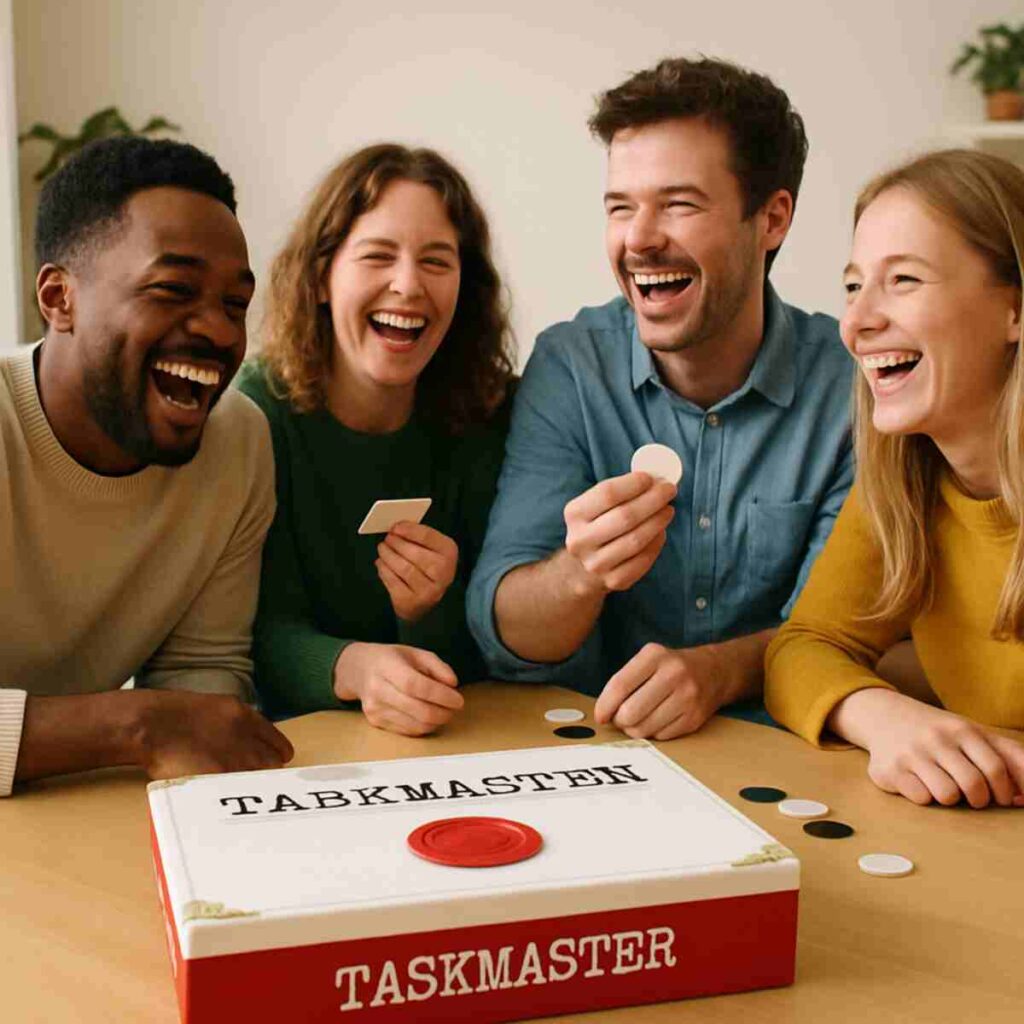
Have you ever watched a contestant on Taskmaster completely bungle a simple task and thought, “I could do that so much better”? Well, the official Taskmaster card game is your chance to finally prove it. This little box turns your living room into the iconic Taskmaster house, putting you and your friends in the hot seat to attempt wonderfully bizarre challenges, all judged by one of your own. Find out the best info about fiona77.
If your usual game nights are feeling stale, this guide is your ticket to creative chaos. We’re skipping the dense rulebook for a quick-start walkthrough that gets straight to the fun, covering how to play, the different roles, and whether Alex Horne’s board game is one of the most fun party games for your group.
The magic of the game, much like the show, isn’t in winning but in the hilarious attempts. It successfully captures the spirit of challenges like “paint a picture of a horse while riding a horse” by focusing on creative interpretation over rigid rules. You don’t need to be an expert strategist; you just need a willingness to look a little foolish for a shot at five points. Prepare to find out which of your friends can write the most heroic poem about a teabag.
What’s Inside the Box? Your Personal Taskmaster Kit
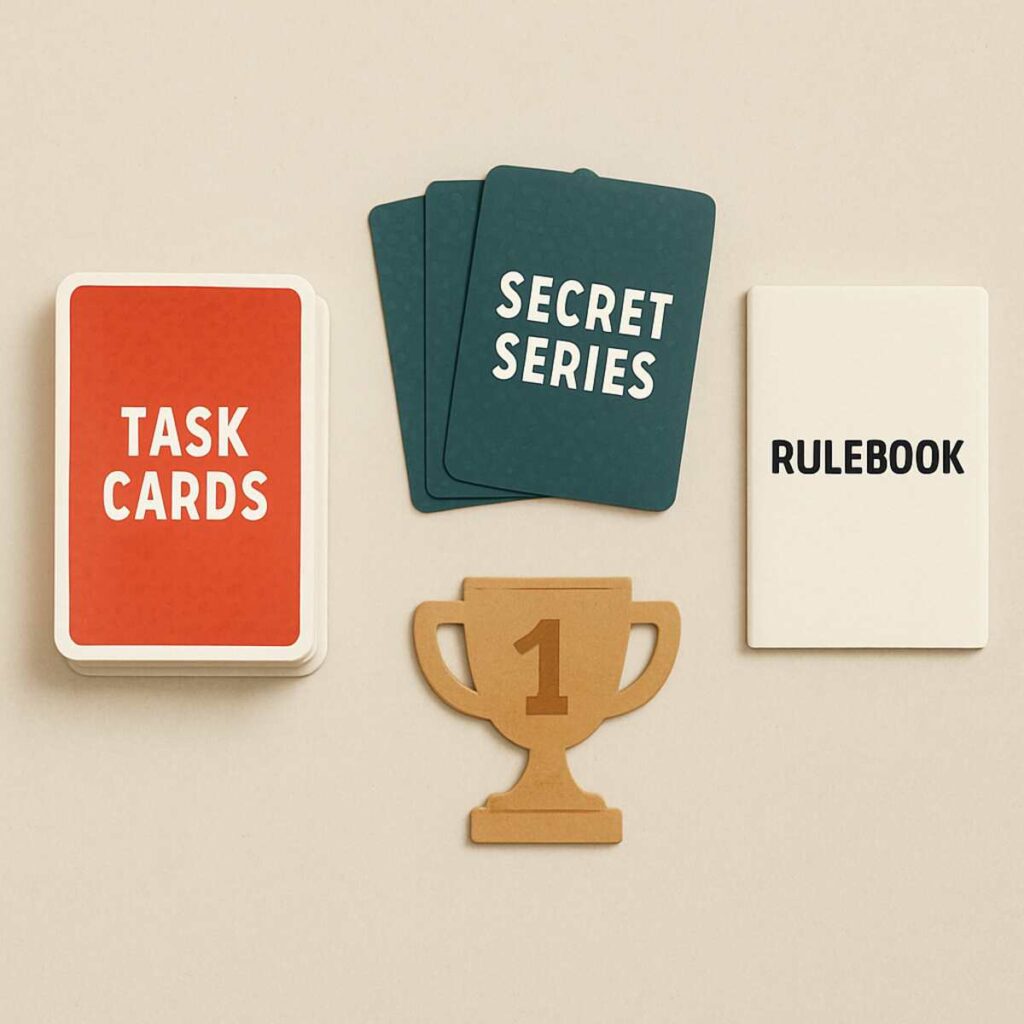
So, what’s inside the Taskmaster game box? Lifting the lid reveals a surprisingly simple kit for creating chaos. You won’t find a complicated board or dozens of tiny pieces. Instead, you get everything you need to replicate the show’s format: two decks of cards, a simple rulebook, and, most importantly, a glorious pop-out trophy to lord over your friends. It’s all designed to get you playing quickly, not bog you down in setup.
The heart of the game is the large deck of Task Cards. Think of these as your personal, wax-sealed envelopes delivered by Little Alex Horne. Each card presents a single, absurd challenge that all players (except the Taskmaster for that round) will attempt. These are the main events, where you’ll be asked to do everything from creating a portrait out of household items to performing an epic slow-motion replay of a mundane event.
Adding a clever twist, the smaller deck of Secret Series Cards brings another layer of fun. At the start of the game, each player gets one of these. It contains a hidden, long-term task you must try to complete throughout the entire game without the other players noticing. It’s your chance to subtly be the most brilliant or sneaky person in the room, just like the series-long tasks from the show.
Finally, you have your ultimate prize. The small cardboard trophy is your golden Greg Davies head, the symbol of absolute victory. While the compact booklet outlines the official Taskmaster game rules, the real goal is to win that trophy and earn eternal bragging rights.
The Core Loop: How to Play Your First Round in Under 5 Minutes
Unlike games that require an hour of setup, you can learn the Taskmaster game rules and instructions in a single round. The key is its simple structure. For each round, one player gets to be the all-powerful Taskmaster (the judge), while everyone else becomes a Contestant. The best part? This role rotates, so everyone gets a turn on Greg Davies’ golden throne, ready to pass down arbitrary and hilarious judgments.
The gameplay itself is a beautifully simple, three-step process that mirrors the show. Knowing this loop is the key to understanding how to play the Taskmaster board game:
- The Taskmaster Draws a Card: They pick a Task Card and read the absurd challenge aloud to the eager Contestants.
- Contestants Attempt the Task: This is where the magic happens! Everyone does their best (or worst) to complete the challenge using their wits and whatever they can find.
- The Taskmaster Awards Points: The judge watches the attempts and, with absolute authority, decides who was the best, funniest, or most creative, awarding points accordingly.
Once points are given out, the round is over. The player to the Taskmaster’s left puts on the metaphorical velvet jacket and becomes the judge for the next task. Playing the Taskmaster game is just a cycle of this creative chaos until one person has enough points to claim the trophy.
How to Be the Taskmaster: Wielding Your Power Like Greg Davies
Taking on the player role of the Taskmaster is your chance to channel the glorious tyranny of Greg Davies. For one round, you are in charge. You don’t have to perform the task; you simply get to read it, watch the chaos unfold, and pass judgment from on high. This isn’t a role about being a neutral referee; it’s about having the most fun by imposing your own completely subjective will on your friends.
The scoring system for the Taskmaster game is wonderfully simple: it’s whatever you say it is. While the task might ask for the “fastest” or “biggest,” you are free to award points for the “most stylish,” “most pathetic,” or “the one that made me laugh the hardest.” Your word is final, and explaining your bizarre logic is half the fun. This is where the game’s true spirit comes alive, moving beyond simple rules and into pure performance.
To make the most of your turn on the throne, keep a few tips in mind. Being a great Taskmaster is all about embracing the entertainment.
- Be decisive: Trust your gut. There are no appeals in the Taskmaster’s court!
- Be dramatic: Announce the scores from last place to first to build maximum tension.
- Have your own logic: Did someone’s attempt remind you of a majestic eagle? 5 points. Was another a sad, crumpled mess? 1 point, for the sheer pity of it.
- Reward the funny: Don’t be afraid to award a bonus point simply because someone’s attempt made you genuinely laugh out loud.
Ultimately, remember that the best moments on the show are rarely about perfect execution. They’re about creative interpretation and hilarious failure. By judging with that in mind, you ensure every round creates a memorable story.
How to Win as a Contestant: Thinking Outside the Box (and the Rules)
Winning as a contestant requires a complete shift in mindset. It’s not about following instructions; it’s about finding the gaps between them. The most successful players treat every task card like a puzzle box with a hidden latch. Read the task, and then read it again. Does it say you can’t use your feet? Does it specify what the “best” drawing is? This is where you find your loopholes. If a task asks you to “get this teabag as far from the table as possible,” you don’t have to throw it. You could mail it to a friend in another country. This kind of creative interpretation is the key to impressing any Taskmaster.
Beyond your clever idea, how you present your attempt is just as critical. A mediocre result sold with unshakeable confidence and a good story will almost always beat a perfect attempt presented with a shrug. You are a lawyer making your final argument to a very easily distracted judge. Did you have to build the tallest tower out of cushions, but it immediately fell over? Don’t present a failure; present “an ambitious monument to gravity’s relentless power.” Your performance in the final moments, explaining your logic and highlighting your genius (or comical lack thereof), can snatch victory from the jaws of defeat.
Finally, never underestimate the power of a glorious failure. Just like on the show, some of the most memorable and high-scoring attempts are not successes, but spectacular disasters. If you realize your plan is doomed, leaning into the comedy of the situation can earn you more points for entertainment than you ever would have received for a boring, competent attempt. The goal isn’t just to win points, but to create a story. Sometimes, the funniest story is about how you managed to get a potato stuck to the ceiling.
The Scoring System Explained: How Points Actually Win Prizes
After all the hilarious attempts and confident presentations, turning your creative genius into points is wonderfully simple. The scoring system for the Taskmaster game is pulled directly from the show. The Taskmaster for that round has absolute power and awards points on a sliding scale: 5 points for their favourite attempt, 4 for the next, and so on, all the way down to a single, glorious point for last place. This ensures that even a spectacular failure earns you something, keeping everyone in the running.
Tracking your triumphs is just as straightforward. All you need is a piece of paper (or the included scorepad) to keep a running total for each player as the rounds progress. Once everyone has had a turn or two in the plush Taskmaster chair—you can decide on the game length before you start—you simply tally up the final scores. The contestant with the highest total at the end is crowned the series champion, earning their place in your personal hall of fame.
So, what does this grand champion win? In true Taskmaster fashion, the prize is both magnificent and ridiculous: ultimate bragging rights and a tiny, golden trophy of the Taskmaster’s head to lord over your friends. It’s the perfect low-stakes reward for a game that’s all about creative chaos, not cutthroat competition. Of course, the points awarded openly by the Taskmaster might not be the only way to sneak ahead on the scoreboard…
The Secret Series Tasks: Adding a Layer of Cunning Deception
Beyond the boisterous main events, the game has a sly, underhanded side, just like the show. This comes in the form of Secret Series Tasks, which bring a little bit of Little Alex Horne’s signature cunning to your game night. At the very start of the game, each player receives one of these secret mission cards that only they can see. This card details a hidden, long-term objective you must try to complete by the game’s end. Pull it off, and you’ll earn a tidy sum of bonus points, potentially catapulting you to victory from behind.
The real challenge is that these aren’t standalone tasks; you have to weave your attempt into the regular rounds, right under everyone’s noses. For instance, your secret task might be to “make another player yawn.” You can’t just tell them to do it. You have to subtly feign tiredness or strategically talk about sleep during your turn, hoping to trigger it naturally. If another player suspects what you’re up to and correctly guesses your task, you fail and get nothing. It’s a brilliant, high-stakes game of social misdirection played in parallel to the main event.
This sneaky element creates a fantastic layer of paranoia that makes every round more engaging. The grand reveal at the end, where everyone confesses their secret missions and finds out who succeeded, is often one of the most hilarious moments of the entire game. This constant variety keeps the game fresh, but what happens when you’ve mastered every card in the box? Fortunately, just like the Taskmaster’s assistant, you’re encouraged to get creative and invent your own.
No Tasks Left? How to Create Your Own Brilliant At-Home Tasks
Eventually, you might crave fresh challenges beyond what’s in the box. Luckily, designing your own tasks is part of the fun and surprisingly simple. Just follow the Taskmaster’s creative formula: combine a simple Objective (what to do), a tricky Restriction (how not to do it), and a vague Metric (what you’re judging on). For example: ‘Get this teabag in a mug [Objective] without using your hands [Restriction]. Most stylish attempt wins [Metric].’ This simple structure is your key to becoming brilliant at-home task creator.
To get you started, here are some of the best Taskmaster at-home task ideas that require little to no setup, making it one of the most flexible and fun party games available:
- Create the most dramatic entrance into the room.
- Write and perform a national anthem for your kitchen.
- Make the best portrait of the Taskmaster using only condiments.
- Perfectly balance a shoe on your head for the longest time.
- Whisper a secret to a houseplant to make it grow faster.
The real magic happens when you tailor tasks to your environment. Look around—that half-empty bottle of ketchup or that lonely-looking broom is all potential props. This DIY approach gives the game near-infinite replay value, as your own home becomes a source of endless inspiration.
Base Game vs. Expansion Pack: Is the Upgrade Worth It?
For many, the question of whether the Taskmaster board game is worth it is answered with a resounding “yes” from the base game alone. It provides hundreds of challenges and a complete, hilarious experience right out of the box. The expansion pack isn’t a necessary purchase for your first game night; rather, it’s a brilliant upgrade for players who have exhausted the original deck and are hungry for more professionally crafted chaos. Think of it as a “season two” for your home game.
The expansion pack’s main draw is a brand-new category of challenge: Location Tasks. These are special cards designed to be performed in specific areas, such as “in the garden,” “in the kitchen,” or even “in a vehicle.” This deck is included alongside a fresh batch of the standard Task and Secret Task cards you already know, ensuring you get more variety across the board. The goal is to push the game beyond the living room table and into the wider world of your home.
This addition cleverly changes the game’s dynamic. While the base game can often be played while sitting around a table, Location Tasks force contestants to get up and physically engage with their surroundings, much like on the show. One round might have you trying to sneak a biscuit into the kitchen, while the next has you creating a work of art in the garden. This makes for a more active and unpredictable party game, adding a layer of logistical absurdity that feels very authentic to Taskmaster.
Ultimately, the choice in the Taskmaster board game vs expansion pack debate is simple. If you are new to the game, stick with the base set—it has more than enough content to keep you entertained for countless sessions. However, if you are a seasoned player who has seen most of what the original box has to offer, the expansion is an excellent investment that breathes new life and exciting movement into your Taskmaster evenings.
The Final Verdict: Is the Taskmaster Game Right for Your Group?
For anyone wondering if the Taskmaster board game is worth it, the answer depends on what you want from a game night. This guide has shown you the creative chaos that awaits, from judging like Greg Davies to thinking like a cunning contestant.
For fans of the show and families seeking a break from typical board games, this is an absolute must-buy. It’s one of the best, most accessible, fun party games based on TV shows. However, for serious gamers who despise subjective rules and crave deep strategy, this game will be more frustrating than fun.
The game’s value boils down to a simple trade-off.
- Pros: It’s incredibly easy to learn, consistently hilarious, and perfectly captures the show’s spirit.
- Cons: The subjective judging can cause friendly arguments, it’s not for players who need a rigid structure, and it often requires a few household props and a bit of space.
Ultimately, the points don’t matter as much as the memories you create. The “winning” move isn’t the one that scores a 5; it’s the bizarre, failed attempt that your friends will bring up for years. Your final task is simple: gather your most creative and ridiculous friends, and find out which one of you is truly the most ingenious. Your time starts now.