



The world of ecommerce operates at lightning speed. Today’s consumers expect their purchases to be acknowledged instantly, shipped within hours, and delivered flawlessly within a day or two. Behind the scenes of this seamless customer experience lies a complex, high-stakes operational web. At the heart of this web is Automated Order Processing for Ecommerce Order Management. The best guide to finding dropshipping order management.
Transitioning from manual workflows to a fully automated system is no longer a luxury for growing online retailers; it is a fundamental requirement for survival. However, deploying automation is rarely as simple as flipping a switch. Navigating the transition from legacy systems to modern digital ecosystems involves overcoming a series of technical, operational, and financial hurdles.
In this comprehensive guide, we will explore the intricate challenges associated with implementing automated order processing solutions. We will dive deep into the technical complexities, explore actionable solutions, and provide you with a strategic roadmap for optimizing your fulfillment operations from checkout to delivery.
Part 1: The Shift from Manual to Automated Operations
Before diving into the challenges, it is crucial to understand the baseline mechanics of order management and why businesses are forced to evolve. The journey of an order—from the moment a customer clicks “Buy” to the moment the package arrives on their doorstep—is fraught with potential points of failure.
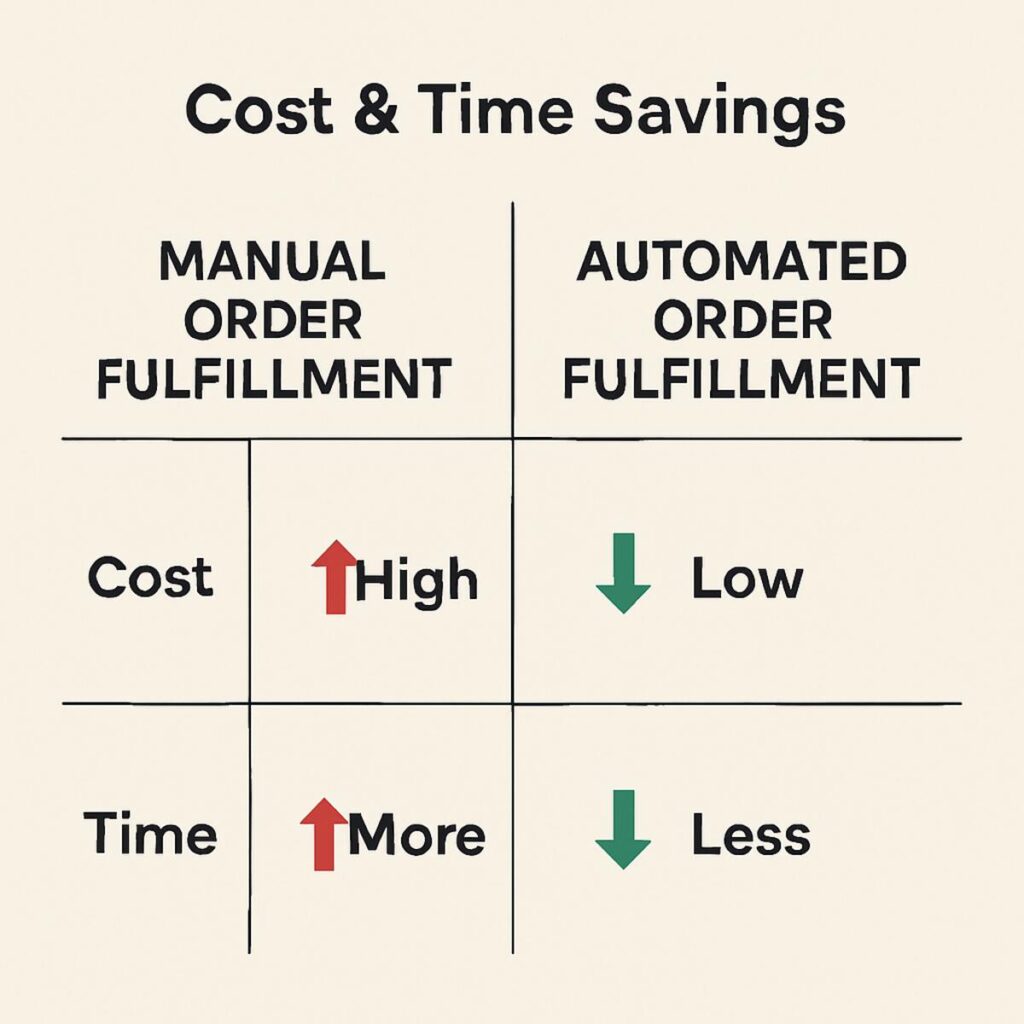
Manual vs Automated Order Fulfillment
When a brand first launches, manual fulfillment is often the default. A small team receives order notifications via email, manually types shipping addresses into carrier portals, deducts items from a spreadsheet, and physically packs boxes.
While this works for 10 or 20 orders a day, the debate between manual vs automated order fulfillment quickly ends when sales volume spikes. Manual fulfillment inherently relies on human intervention at every stage, making it slow, expensive to scale, and highly susceptible to errors.
Conversely, automated order processing relies on digital triggers. An order is placed, and the system automatically verifies payment, checks inventory, routes the order to the optimal warehouse, generates picking lists, and prints shipping labels—all in milliseconds, without human intervention.
The Financial Reality: Cost of Manual Order Processing vs Software
One of the primary drivers toward automation is financial efficiency. Understanding the cost of manual order processing vs software is critical for any operations manager.
- The Hidden Costs of Manual Processing: It goes beyond hourly wages. Consider the cost of a mis-shipped item. You pay for the initial shipping, the return shipping, the replacement shipping, the cost of the replacement good if the original is damaged, and the customer service hours spent apologizing. Furthermore, you risk losing the customer’s lifetime value (LTV).
- The ROI of Software: Implementing robust order processing software requires an upfront investment and monthly SaaS fees. However, the return on investment (ROI) is realized through drastic reductions in labor costs, near-elimination of fulfillment errors, faster shipping times, and the ability to handle Black Friday-level volumes without hiring temporary staff.
The Heart of the Operation: The Order Management System
To facilitate this automation, businesses rely on an order management system (OMS). An OMS acts as the central brain of your retail operations. It captures demand from your storefronts and orchestrates the fulfillment of that demand across your supply chain.
However, installing an OMS is where the true challenges begin. Achieving true ecommerce order lifecycle automation—where every step from cart to customer is hands-free—requires seamless communication between disparate systems that were often never designed to speak to one another.
Part 2: Integration Complexities and Data Flow
The most significant barrier to successful automation is integration. A modern ecommerce business uses a multitude of software platforms: an ecommerce storefront (like Shopify or BigCommerce), an ERP (Enterprise Resource Planning), a WMS (Warehouse Management System), and various accounting and marketing tools. Getting them to communicate flawlessly is a monumental challenge.
Integrating the Backbone: How to Integrate ERP with Online Stores
For mid-market and enterprise businesses, the ERP is the ultimate source of truth for financials, procurement, and HR. However, connecting this massive backend system to a nimble frontend online store is notoriously difficult.
Learning how to integrate ERP with online stores involves navigating several technical hurdles:
- Legacy Architecture: Many legacy ERPs rely on batch processing (updating once a day) rather than real-time data transfers. Online stores require real-time data to prevent overselling.
- Data Mapping: The way an ERP formats a customer address or SKU might differ entirely from how the ecommerce platform formats it. Creating translation layers (middleware) is essential.
- API Limitations: While modern systems use robust APIs, some ERPs have strict rate limits, meaning they can only process a certain number of requests per minute, which becomes a bottleneck during flash sales.
Actionable Tip: When integrating an ERP with your online store, utilize an Integration Platform as a Service (iPaaS). These specialized middleware platforms come with pre-built connectors that translate data between your storefront and your ERP, saving thousands of hours of custom coding.
The Need for Speed: Benefits of Real-Time Inventory Synchronization
When your systems aren’t speaking to each other instantly, you face the nightmare of overselling—selling an item that is actually out of stock.
One of the greatest challenges in automation is achieving true real-time syncing. The benefits of real-time inventory synchronization cannot be overstated. When inventory levels update globally across all platforms the second an item is purchased, you achieve:
- Zero Backorders: Customers are never disappointed by “out of stock” emails post-purchase.
- Optimized Safety Stock: You no longer need to hold massive amounts of safety stock “just in case,” freeing up working capital.
- Accurate Forecasting: Your purchasing team has an exact, up-to-the-minute view of stock velocity, allowing for precise reordering.
Data Ingestion and Reducing Errors
Automation is only as good as the data it receives. If bad data enters the system, the automation will simply execute mistakes faster. Therefore, reducing manual data entry errors at the very beginning of the order lifecycle is paramount.
While direct API integrations handle most consumer orders seamlessly, B2B orders or customized requests often come through emails, PDFs, or manual purchase orders (POs).
To solve this, modern businesses are improving order accuracy with OCR (Optical Character Recognition) technology. OCR software can scan a PDF purchase order emailed by a wholesale client, automatically extract the SKUs, quantities, and shipping addresses, and inject that data directly into the order management system. This completely bypasses the need for a human to re-type the order, eliminating keystroke errors and drastically speeding up the time-to-fulfillment.
Part 3: Navigating Omnichannel and Multi-Channel Complexities
Today’s consumers do not just shop on your website. They shop on Instagram, Amazon, Walmart marketplace, physical retail stores, and wholesale portals. Managing orders from a single channel is straightforward; managing them from ten is a logistical puzzle.
Multi-Channel Sales Order Orchestration
When you sell across multiple platforms, you are dealing with different service level agreements (SLAs). Amazon Prime requires strict two-day shipping and precise labeling, whereas a direct website order might have more flexible terms.
Multi-channel sales order orchestration is the challenge of routing these disparate orders logically. An automated system must evaluate every incoming order and ask:
- Where is this customer located?
- Which warehouse or 3PL has the necessary stock closest to the customer?
- What are the SLA requirements for the channel this order came from?
- What is the cheapest shipping method that meets the delivery deadline?
Orchestrating this requires a highly intelligent rules engine within your OMS. If the logic is flawed, you might end up shipping an item from New York to California, even though your Nevada warehouse had the item in stock, unnecessarily eating into your profit margins.
The Rise of Headless Architecture
To manage multi-channel complexities, many brands are moving away from traditional monolithic software architectures. This brings us to a common question in modern operations: what is headless commerce order management?
In simple terms, “headless” means decoupling the front-end presentation layer (what the customer sees, like your website, a mobile app, or an IoT device) from the back-end commerce engine (where the inventory and order processing live).
The challenge here lies in the implementation. Because there is no out-of-the-box front-end, your development team must use APIs to connect the headless OMS to all your varied sales channels. While it presents a steep initial learning curve and higher development costs, it offers unparalleled flexibility. You can add a new sales channel (like a smart-watch shopping app or a voice-activated purchasing skill) without ever having to rebuild your backend order processing logic.
Part 4: Warehouse and Logistics Automation
Once the order is captured, validated, and routed, the physical challenge begins. Automating the flow of data to the warehouse floor and eventually to the shipping carrier is where physical constraints meet digital solutions.
Streamlining Warehouse Management System Workflows
The gap between the Order Management System and the Warehouse Management System (WMS) is a common site for operational friction. Streamlining warehouse management system workflows requires that the digital order translates seamlessly into physical action.
Challenges in WMS automation include:
- Batch Picking vs. Single Order Picking: The WMS must automatically group orders logically. If ten customers order the exact same t-shirt, the automated system should instruct the picker to grab ten shirts at once, rather than making ten separate trips to the same aisle.
- Routing Optimization: Automation should calculate the most efficient walking path for warehouse staff to minimize travel time.
- Pack Verification: Utilizing barcode scanners at the packing station ensures that the item in the box matches the digital order perfectly, effectively eliminating bottlenecks in the fulfillment chain caused by quality control delays.
Logistics and 3PL Integration
Many growing ecommerce brands do not own their warehouses; instead, they outsource to Third-Party Logistics (3PL) providers. The challenge here is loss of direct control. You are relying on a separate company’s software and staff to fulfill your brand’s promise.
Flawless API integration for third-party logistics is non-negotiable. Your OMS must push the order to the 3PL’s WMS instantly. More importantly, the 3PL must push tracking data and inventory deductions back to your OMS in real-time. If the API connection drops or lags, you might continue selling inventory the 3PL no longer has, or you might fail to send tracking emails to anxious customers.
Shipping Automation and Logic
Shipping is consistently one of the highest variable costs for any ecommerce business. Manual shipping decisions—such as a packer guessing which box size to use or which carrier is cheapest—lead to massive financial waste.
Knowing how to set up automated shipping rules within your processing software is a game-changer. These rules act as a series of “If/Then” statements operating in the background.
Examples of Automated Shipping Rules:
- IF order weight is < 16oz AND destination is domestic, THEN automatically assign USPS Ground Advantage.
- IF order contains hazardous materials (like nail polish or lithium batteries), THEN flag for ground shipping only and automatically print required Hazmat labels.
- IF order value is > $500, THEN automatically require a signature upon delivery and add shipping insurance.
- IF order includes SKU “WinterJacket_Large”, THEN recommend Box Size #4 to the packer.
Setting up these rules is a tedious initial challenge, requiring you to map out every possible scenario and dimension your entire product catalog. However, once established, it removes human decision-making from the packing bench, speeding up output and ensuring you pay the absolute lowest shipping rate for every single package.
Part 5: B2B Complexities and Scalability
While Direct-to-Consumer (DTC) ecommerce is largely standardized, Business-to-Business (B2B) ecommerce presents a wild frontier of complexity. If your brand sells both DTC and B2B, automating the entire spectrum requires advanced capability.
Navigating EDI Standards for B2B Ecommerce
When dealing with large wholesale clients, big-box retailers, or major distributors, you cannot simply send them a Shopify link to buy your products. Large enterprises require data to be transmitted through strictly formatted, highly secure channels.
This is where Electronic Data Interchange (EDI) comes into play. Complying with EDI standards for B2B ecommerce is one of the most formidable challenges for growing brands. EDI is a standardized format that allows computer systems to exchange business documents—like Purchase Orders (EDI 850), Advanced Shipping Notices (EDI 856), and Invoices (EDI 810)—without human intervention.
The Challenges of EDI:
- Strict Compliance: Every major retailer (e.g., Target, Walmart, Nordstrom) has slightly different EDI requirements and routing guides. Failing to format your data exactly as they demand results in hefty financial penalties known as chargebacks.
- Implementation Costs: Setting up EDI requires specialized software or a dedicated Value-Added Network (VAN) provider.
- Integration with OMS: Your automated order processing system must be capable of translating incoming EDI documents into standard orders, and then automatically generating and sending the required outgoing EDI documents as the order is fulfilled.
Despite the headaches, conquering EDI automation unlocks massive revenue streams by allowing you to seamlessly act as a supplier for the world’s largest retailers.
Future-Proofing: Scaling Ecommerce Operations with Automation
The ultimate goal of overcoming all these challenges is growth. Scaling ecommerce operations with automation means building a system that doesn’t just work for your current volume, but can handle 10x or 100x that volume without cracking.
As you look to the future, scaling involves moving beyond simple rule-based automation and embracing intelligent automation:
- Predictive Analytics: AI-driven systems that can predict inventory needs based on historical data, weather patterns, and social media trends, automatically generating purchase orders to your suppliers before you run out of stock.
- Dynamic Order Routing: Machine learning algorithms that adjust fulfillment logic on the fly. If an East Coast blizzard is delaying FedEx shipments, the system automatically routes East Coast orders to a Midwest warehouse using UPS to bypass the weather delay.
- Automated Exception Management: The system handles 99% of orders automatically, but when an exception occurs (e.g., an invalid address or a flagged fraudulent order), it automatically quarantines the order and alerts a human operator, providing them with all the context needed to make a rapid decision.
Actionable Strategies for Overcoming Automation Challenges
Transitioning to automated order processing can feel overwhelming. To ensure a smooth transition and maximize your investment, follow these strategic steps:
1. Audit Your Current Workflows
Before buying software, document every step of your manual process. Where are the bottlenecks? Where do errors most frequently occur? You cannot automate a broken process; you must fix the process first, then automate it.
2. Prioritize Data Hygiene
Automation relies on clean data. Ensure your SKUs are uniform across all platforms. Make sure every product has accurate weight and dimension data recorded. Clean up your customer databases. A small data discrepancy can cause cascading automated failures.
3. Choose Systems with Open APIs
When selecting an Order Management System, WMS, or ERP, prioritize platforms with modern, well-documented APIs. The ability for software to “talk” to other software easily is the foundation of modern automation. Avoid closed ecosystems that trap your data.
4. Implement in Phases
Do not try to automate everything overnight. Start with the easiest, most impactful wins.
- Phase 1: Automate order import from your website to your OMS.
- Phase 2: Implement automated shipping rules based on weight.
- Phase 3: Move on to complex real-time inventory syncing across multi-channel platforms.
- Phase 4: Tackle B2B EDI integrations.
5. Invest in Team Training
Automation does not eliminate the need for humans; it elevates their roles. Your team will transition from data-entry clerks to systems managers. Invest heavily in training them on how to read the new dashboards, how to manage exceptions, and how to optimize the automated rules.
Summary and Conclusion
Mastering Automated Order Processing for Ecommerce Order Management is an ongoing journey rather than a final destination. As ecommerce continues to evolve, consumer expectations will grow, and the technology required to meet those expectations will become more advanced.
We have explored how transitioning from manual labor uncovers the stark differences in the cost of manual order processing vs software. We’ve seen that laying the foundation with a robust order management system and achieving true ecommerce order lifecycle automation requires overcoming significant technical hurdles—from understanding how to integrate ERP with online stores to reaping the benefits of real-time inventory synchronization.
Whether it is improving order accuracy with OCR for manual POs, demystifying what is headless commerce order management for omnichannel growth, or streamlining warehouse management system workflows, the goal remains the same: eliminating bottlenecks in the fulfillment chain.
For brands selling everywhere, mastering multi-channel sales order orchestration and establishing precise API integration for third-party logistics ensures that every customer receives the same premium experience. Furthermore, knowing how to set up automated shipping rules protects your profit margins, while adhering to EDI standards for B2B ecommerce opens doors to massive wholesale opportunities.
Ultimately, scaling ecommerce operations with automation and prioritizing reducing manual data entry errors allows business owners to step away from the daily grind of order fulfillment. By embracing automated order processing and investing in the right order processing software, you empower your business to stop reacting to orders and start proactively growing your brand.
The challenges are real, the integrations are complex, but the reward—a resilient, highly profitable, and infinitely scalable ecommerce operation—is well worth the effort.